

Inflammation of the pancreas, or pancreatitis , is a serious health problem that can appear either as a sudden, acute crisis or as a slowly progressing, chronic process. Recognising the symptoms early and making an accurate diagnosis are crucial to avoid life-threatening complications.
What is pancreatitis?
Pancreatitis is inflammation of the pancreas that occurs when digestive enzymes become active while still inside the gland and start to “digest” its tissue.
Acute pancreatitis – an emergency
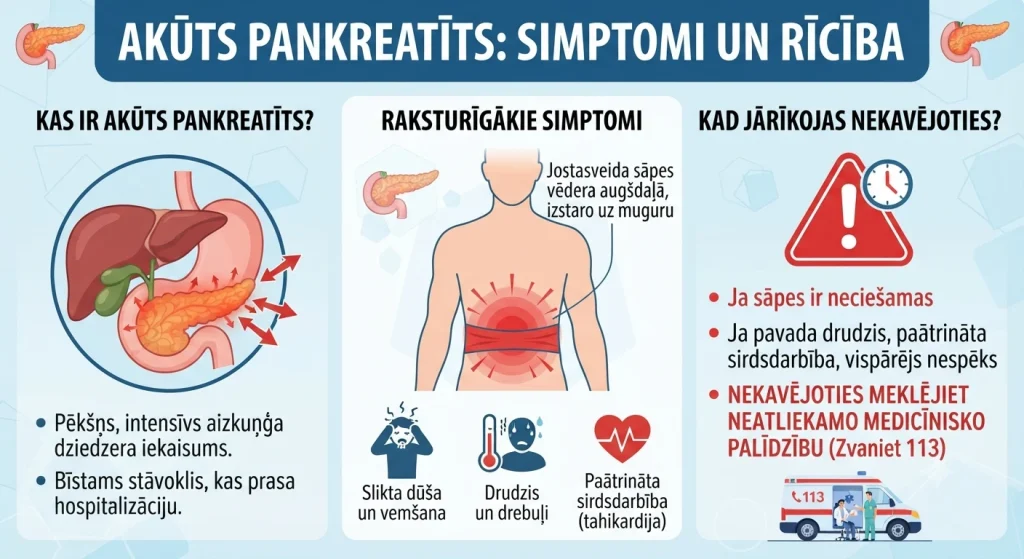
Acute pancreatitis is sudden, intense inflammation. It often shows up as very strong, sudden “belt-like” pain in the upper abdomen that spreads to the back, together with nausea and vomiting.
- When to act immediately – if the pain is unbearable and comes with fever, a fast heartbeat and general weakness, seek emergency medical help straight away. This is an acute condition that requires hospitalisation.
Chronic pancreatitis – progressive damage
Chronic pancreatitis develops when inflammation becomes long-term, causing tissue fibrosis (scarring). This leads to irreversible changes that affect both digestion (exocrine insufficiency) and insulin production (type 3c diabetes).
- Exocrine insufficiency – the gland can no longer produce enough enzymes to digest fats, proteins and carbohydrates
- Endocrine insufficiency – damage to the islets of Langerhans leads to impaired insulin production, resulting in diabetes
Why does pancreatitis develop?
International medical literature uses the TIGAR-O classification system to identify the causes of chronic pancreatitis:
- T (Toxic damage) – excessive alcohol use (the most common cause), smoking (a catalyst that speeds up progression), hypercalcaemia, chronic kidney failure.
- I (Idiopathic) – cases where the cause cannot be found.
- G (Genetic) – mutations in the CFTR, PRSS1 and SPINK1 genes. Especially important in early-onset cases.
- A (Autoimmune) – autoimmune pancreatitis (types 1 and 2), which often mimics a tumour.
- R (Recurrent) – repeated episodes of acute pancreatitis that turn into the chronic form.
- O (Obstructive) – blockage of the pancreatic duct (Wirsung’s duct) due to a tumour, strictures or traumatic injury.
Symptoms of pancreatitis – what to look out for?
The signs of chronic pancreatitis can be deceptive. In many patients the symptoms are mild in the early stages, but as fibrosis progresses they become pronounced.
Pain
Pain is the most common sign of chronic pancreatitis (around 80–90% of patients). It is characterised by:
- Location – in the epigastrium (upper abdomen), spreading to the back (between the shoulder blades).
- Character – dull, aching pain that often gets worse 15–30 minutes after eating (especially fatty food).
- Paradoxical relief – the pain may ease slightly when leaning forward (the “pancreatitis posture”), which reduces pressure on the nerve plexuses of the pancreas.
Exocrine insufficiency
When 90% of the functional pancreatic tissue is damaged, exocrine insufficiency develops:
- Steatorrhoea – stools are fatty, shiny, very foul-smelling and hard to flush. This indicates that fat is not being digested.
- Weight loss – despite a normal or increased appetite, the patient loses weight because the body cannot absorb nutrients.
- Vitamin deficiency – low levels of fatty acids and fat-soluble vitamins (A, D, E, K).
Endocrine insufficiency
Chronic pancreatitis can cause so-called “type 3c diabetes”. Unlike type 1 or type 2 diabetes, in this case both the insulin-producing and the glucagon-producing cells are destroyed. This makes patients especially prone to sharp swings in blood sugar and hypoglycaemia.
Diagnosis of pancreatitis
Making the diagnosis is a complex process, because in the early stage the symptoms can be non-specific. Chronic pancreatitis cannot be diagnosed with blood tests alone, so in addition to blood tests an abdominal ultrasound should be done and, if needed, a surgeon should be consulted.
Laboratory tests
Important to understand: blood tests (amylase/lipase) are often normal in the chronic form.
- Faecal elastase-1 – the gold standard for detecting exocrine insufficiency. A value below 200 µg/g indicates moderate insufficiency, below 100 µg/g – severe insufficiency.
- HbA1c and glucose levels – early diagnosis of diabetes.
- Serum IgG4 level – important to rule out autoimmune pancreatitis.
Imaging methods
- Abdominal ultrasound (USG) – the first-choice method for detecting dilated ducts and calcifications.
- Endoscopic ultrasound (EUS) – the highest accuracy. It shows even the smallest changes in the tissue that a standard ultrasound or CT does not reveal, because the pancreas can be viewed from the inside. However, this test is not easily available.
- MRCP (magnetic resonance cholangiopancreatography) – a non-invasive method that visualises the pancreatic duct system.
Treatment of pancreatitis
The aim of treatment is to control pain, prevent complications and maintain quality of life.
- Lifestyle changes – stopping alcohol and smoking completely is absolutely essential. Smoking speeds up the development of fibrosis.
- Pancreatic enzyme replacement therapy (PERT) – taking pancreatin preparations with meals to replace the missing enzymes.
- Pain relief – starts with simple painkillers but often requires medicines that act on the nervous system, or even surgery.
- Surgical or endoscopic intervention – indications are chronic, unbearable pain, duct strictures, stones in the ducts or suspected malignancy (cancer). An experienced surgeon’s consultation is essential here to assess whether a drainage operation or resection is needed.
Surgeon consultation
Many patients mistakenly believe that a surgeon is only needed to perform an operation. In fact, a surgeon consultation at Republikas laukuma klīnika is a strategic step to determine:
- Pain management – chronic pancreatitis often causes unbearable pain that cannot be controlled by diet alone.
- Prevention of complications – if an abdominal ultrasound shows ducts that are significantly narrowed or blocked, the surgeon assesses the need for minimally invasive intervention.
- A multidisciplinary approach – cooperation between a gastroenterologist and a surgeon ensures you receive not just symptomatic treatment, but a long-term solution for your health.

Dr. Jānis Opincāns
General surgeon
Acute pancreatitis can be cured if treated in time. Chronic pancreatitis is a progressive disease, which means that the scar tissue (fibrosis) that has formed does not regenerate. However, with proper treatment and lifestyle restrictions it is possible to stop the progression of the disease completely and live a full life.
In chronic pancreatitis, amylase and lipase levels in the blood rise only during acute flare-ups. Between flare-ups these values can be completely normal, which is why faecal elastase and imaging methods are used for diagnosis.
A surgeon is not only someone who operates. They assess mechanical changes (duct blockages, cysts, tumours) and help decide whether surgical drainage or resection would significantly improve the patient’s quality of life and pain level.
Questions about your health?
Specialist doctors see patients at Republikas laukuma klīnika in central Riga. Our reception will help you choose the right specialist and time.