Anatomical changes in the intimate area can remain unnoticed until they cause discomfort or interfere with everyday activities. One of the more common but less frequently discussed gynaecological conditions is a Bartholin gland cyst.
According to international medical data and clinical observations, approximately 2% of women develop a Bartholin gland cyst during their lifetime. Although most of these cysts are benign and painless, they can significantly affect quality of life and raise questions about appropriate treatment and the risk of recurrence.
What is a Bartholin gland and how does a cyst develop?
Two small, pea-sized Bartholin glands are located on either side of the vaginal opening, approximately at the 4 o’clock and 8 o’clock positions. Their main function is to produce a clear, mucus-like fluid that helps provide natural lubrication and protect the mucous membranes during sexual intercourse.
This fluid travels through narrow ducts that are approximately 2 centimetres long. If a duct becomes blocked, the mucus cannot drain normally. It accumulates, causing the gland to swell gradually and form a fluid-filled cavity known as a cyst.
Causes of Bartholin gland duct blockage
- Infections and inflammation — sexually transmitted infections such as chlamydia or gonorrhoea, as well as inflammation caused by bacteria normally present in the genital area, can cause swelling and narrowing of the duct.
- Trauma or scar tissue — thickening of the tissue lining the duct or scarring caused by previous minor injuries, childbirth-related trauma or surgical procedures can mechanically narrow the duct and block fluid drainage.
- Thickened gland secretions — factors such as local hormonal changes or mild inflammation can make the gland’s secretions thicker and more viscous. The fluid may then be unable to pass freely through the narrow duct, resulting in a blockage.
Symptoms of a Bartholin gland cyst
The symptoms largely depend on the size of the cyst and whether a bacterial infection is present. In clinical practice, two main conditions are distinguished.
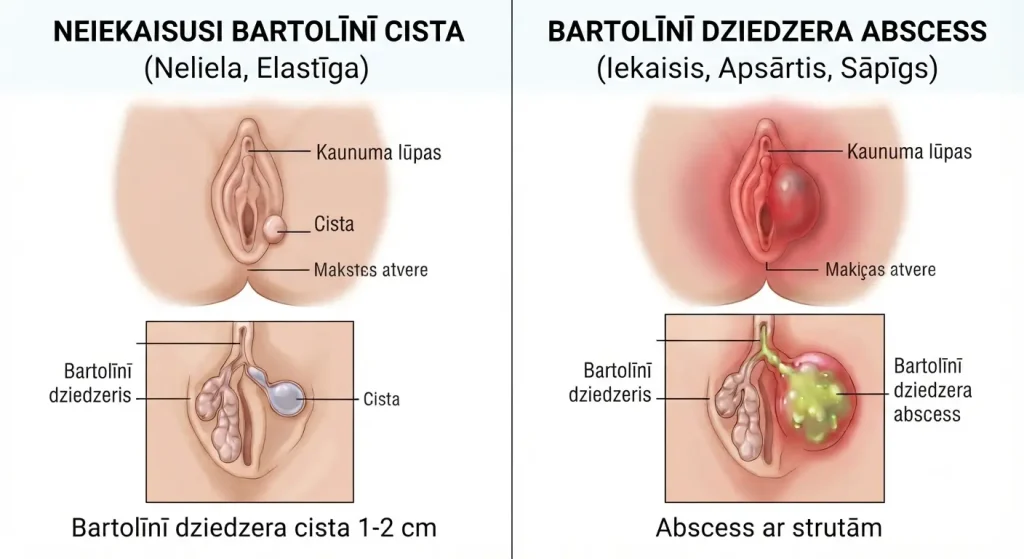
An uninfected Bartholin gland cyst
- No symptoms — small cysts are often completely painless and may be discovered accidentally.
- Visible or palpable lump — a small, soft or elastic lump may be present on one side of the vaginal opening. The skin over the cyst is usually not red or inflamed.
- The gynaecologist’s approach — if the cyst does not cause pain or discomfort, international guidelines often recommend observation without immediate surgical treatment.
A Bartholin gland abscess
If bacteria enter the cyst, the fluid inside it may turn into pus and cause an acute infection known as an abscess. The symptoms then become more pronounced and painful:
- Severe, throbbing pain — the pain may worsen when walking, moving, sitting or adopting certain positions.
- Local swelling and redness — the skin and mucous membrane around the cyst may become red and inflamed, while the swelling can increase rapidly.
- General symptoms — in more severe cases, fever and chills may occur, indicating a systemic response to the infection.
Can a Bartholin gland cyst be treated without surgery?
One of the questions most frequently asked by patients during consultations and on international health forums is: “Can a Bartholin gland cyst be treated without surgery?”
The answer depends on the stage and severity of the condition:
- Conservative treatment — when a cyst is small and not infected, a gynaecologist may recommend warm sitz baths several times a day. The warmth improves local blood circulation and may help the duct open and drain naturally. However, sitz baths and warm compresses do not remove the cyst wall. They can only reduce discomfort and relieve mild symptoms.
- Surgical and minimally invasive treatment — if the cyst becomes large or develops into an abscess, conservative measures are usually no longer sufficient. A medical procedure or surgical treatment may then be required.
Important warning — never attempt to puncture, squeeze or open the cyst at home using non-sterile instruments. Doing so can cause a serious bacterial infection, damage surrounding tissue and, in rare cases, lead to sepsis.
- Consult a gynaecologist — if you notice a lump or experience discomfort in the intimate area, the first step should be an examination by a qualified gynaecologist. The diagnosis should be confirmed professionally because other conditions can cause similar symptoms.
- Avoid self-treatment with aggressive products — do not apply unverified ointments or strong irritating solutions to the affected area without medical advice.
A Bartholin gland cyst is a common and treatable gynaecological condition. If the cyst is small and not infected, a doctor may recommend observation or warm compresses. If it becomes infected or grows larger, modern medicine offers safe and effective treatment options. If you experience discomfort or pain, arrange a consultation with a gynaecologist to find the most appropriate long-term solution for your situation.
How much does surgical treatment of a Bartholin gland cyst cost?
Surgical removal of a Bartholin gland cyst — €500.00
Incision of a Bartholin gland cyst — €300.00
Frequently asked questions
Can a Bartholin gland cyst disappear on its own?
Yes, a small and uninfected cyst may sometimes resolve on its own. If the blocked duct reopens, the accumulated fluid can drain gradually and the swelling may disappear. However, this does not always happen. If the cyst is large or causes discomfort, medical treatment such as professional drainage or surgical removal may be required.
Does a Bartholin gland cyst affect pregnancy or fertility?
A Bartholin gland cyst does not normally affect a woman’s ability to become pregnant. However, a cyst that develops during pregnancy requires medical assessment. Hormonal changes and increased blood flow during pregnancy may contribute to cyst enlargement or abscess formation.
Why do Bartholin gland cysts recur?
One of the main reasons for recurrence is treatment that drains the cyst without creating a lasting drainage opening. If an incision closes or heals completely, the gland’s duct may become blocked again by thick secretions or scar tissue.