
Republikas laukuma klīnika
Cardiotocography (CTG)
In the last trimester of pregnancy and during labour, expectant mothers have a number of tests, but one of the most important tools for assessing the baby’s wellbeing is cardiotocography (CTG). Although it has been used in clinical practice since the 1960s, interpreting the results still requires a high level of expertise and precision.
Price: €30 · Republikas laukums 3–18, Riga · Tel. 28002363
If you are looking for a safe, professional place to have cardiotocography in Riga, Republikas laukuma klīnika offers high-quality CTG monitoring with a certified midwife.
Cardiotocography (CTG) in Riga
Cardiotocography records two independent physiological signals at the same time:
- Fetal heart rate (FHR) – measured in beats per minute (bpm).
- Uterine activity – measures uterine tone and the frequency and duration of contractions.
The test uses two main sensors, which are attached to the mother’s abdomen with elastic belts.
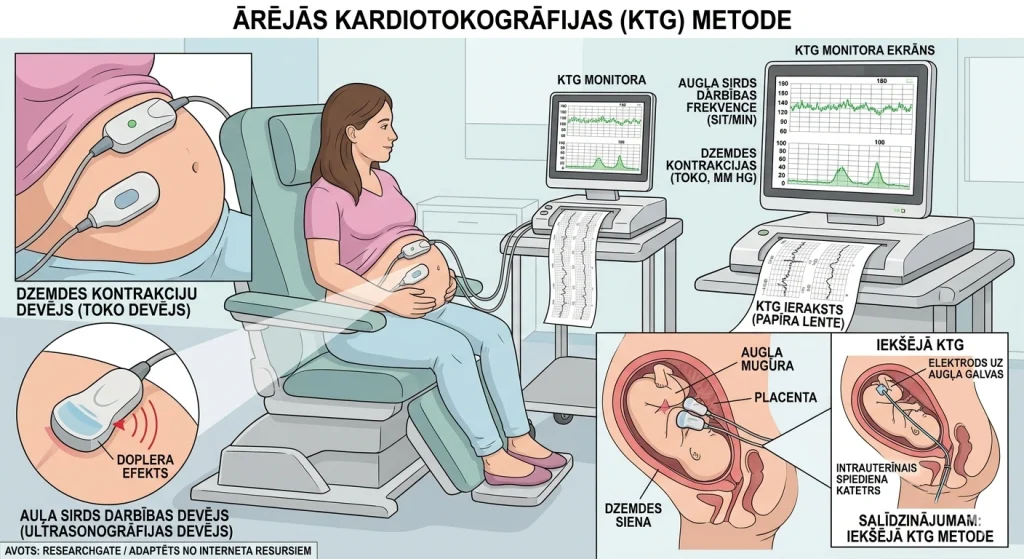
As shown in the image, the procedure is usually non-invasive (external):
- Ultrasound transducer – uses the Doppler effect to detect and record the movement of the baby’s heart valves and blood flow. It is placed where the heartbeat is heard best (usually over the baby’s shoulder).
- Tocodynamometer (Toco) – a pressure-sensitive sensor that responds to tightening of the abdominal wall during a contraction. It is placed over the top of the uterus (fundus).
The data is shown on a monitor in real time and printed on a paper strip (the cardiotocogram): the upper line shows the heart rate and the lower line shows uterine activity.
When and why is CTG recommended?
The International Federation of Gynecology and Obstetrics (FIGO) and the American College of Obstetricians and Gynecologists (ACOG) state that routine antenatal CTG is not needed in low-risk pregnancies. However, there are clear indications when this monitoring is essential.
Antenatal monitoring
It usually starts no earlier than week 26–28 of pregnancy, because before then the baby’s autonomic nervous system is not mature enough to give clinically meaningful heart rate variability. The main indications are:
- Maternal health conditions (pre-eclampsia, gestational diabetes, chronic hypertension).
- Fetal growth restriction (IUGR – intrauterine growth restriction).
- Reduced fetal movements reported by the mother.
- Prolonged pregnancy (after week 41).
- Multiple pregnancy.
- Oligohydramnios or polyhydramnios (too little or too much amniotic fluid).
Monitoring during labour
During labour the uterus contracts, which temporarily reduces blood flow through the placenta. A healthy baby tolerates this easily, but if its reserves run low, hypoxia (lack of oxygen) can develop. CTG helps detect this in time.
Safety and myths about CTG
Because CTG involves electronic equipment and the word “ultrasound”, a few unfounded myths circulate. Let’s look at them with the facts.
- Myth: CTG radiation harms the baby.
- Fact – a CTG machine does not use any ionising radiation (X-rays or radiation). It works with low-intensity ultrasound waves, which are completely safe for both mother and baby, even with prolonged use. The WHO considers the method harmless.
- Myth: if the baby’s heart rate jumps above 160 during CTG, something is wrong.
- Fact – quite the opposite. A short rise in heart rate (an acceleration) in response to movement or a contraction is a sign of a healthy, responsive baby. It shows that the central nervous system is coping well.
- Myth: CTG stops a woman from moving during labour.
- Fact – traditional CTG machines do keep the patient near the bed with cables. However, modern clinics increasingly use wireless (telemetry) CTG sensors that are waterproof. They let the mother move freely, sit on a birthing ball or even be in the bath while monitoring continues.
How to prepare for a CTG
Although the procedure is simple, a few practical steps can help get an accurate recording first time and avoid unnecessary stress.
- Have a light meal before the test – a rise in the mother’s blood glucose stimulates the baby’s activity. If you come on an empty stomach, the baby may be sleepy, so the CTG may show reduced variability and the test may need to be extended.
- Use the toilet beforehand – the test takes 20 to 40 minutes on average. Sitting or lying with a full bladder can be uncomfortable, which may affect your blood pressure and, indirectly, the CTG data.
- Find a comfortable position – you should not lie flat on your back. In this position the heavy uterus can press on the inferior vena cava, reducing blood flow back to the heart and causing a sudden drop in your blood pressure and a slow fetal heart rate (supine hypotension syndrome). The best positions are semi-sitting or lying on your left side.
Cardiotocography at Republikas laukuma klīnika in Riga
Because CTG is highly sensitive to technical artefacts and carries a risk of false-positive results, the quality of the test – and your peace of mind – depends directly on the specialist’s expertise. At “Republikas laukuma klīnika“, CTG is performed and monitored by an experienced certified midwife.
While automated algorithms only record numbers, a certified midwife can recognise the baby’s sleep cycles in real time, tell maternal pulse artefacts apart and use gentle positioning techniques. We use modern equipment in line with the latest international FIGO guidelines.
- Price of cardiotocography: €30.00
- Address: Republikas laukums 3–18, Riga
Take care of your baby’s safety and your own peace of mind. Book a cardiotocography (CTG) appointment with a certified midwife at Republikas laukuma klīnika today!
Take care of your baby’s safety and your own peace of mind. Book a CTG appointment with a certified midwife at Republikas laukuma klīnika today for careful care that meets international standards.
Have questions?
Contact our reception — we will help you choose a specialist and book an appointment.