Republikas laukuma klīnika
Mole Removal in Riga
At Republikas laukuma klīnika, a general surgeon surgically removes moles and other skin lesions under local anaesthesia.
Republikas laukums 3–18, Riga · Tel. 28002363
Specialists

A key advantage of the surgical method is that the lesion can be removed in its full depth and the tissue preserved for histological examination. The laboratory can then determine exactly what type of lesion was removed and check its cells for any undesirable changes.
Book a surgeon consultation if a mole:
- is regularly irritated by clothing or jewellery;
- gets in the way when shaving;
- is markedly raised above the skin;
- itches, hurts, becomes inflamed or bleeds;
- has changed in size, shape or colour;
- causes physical or cosmetic discomfort;
- has been recommended for removal after a dermatologist’s examination.
During the consultation, the surgeon will assess the lesion and explain the most suitable removal approach.
Mole and skin lesion removal prices
- Surgeon consultation – €60
- Surgical removal of one small skin lesion under local anaesthesia – €100.00–140.00
- Removal of a lesion on the face, scalp or another difficult area – € 160.00–190.00
- Each additional small lesion removed during the same procedure – € 40.00–60.00
- Histological examination – € 40.00
- Post-operative check-up and suture removal – included in the procedure price
The surgeon determines the exact price during the consultation, taking into account the size, depth and location of the lesion and the number of lesions to be removed.
Histological examination is not included in the procedure price.
Why choose surgical mole removal?
During surgical excision, the doctor removes the entire skin lesion, together with a small margin of surrounding tissue if necessary. The wound is usually closed with stitches to support proper healing and the neatest possible scar.
The surgical method has several important advantages:
- the lesion can be removed in its full depth;
- the removed tissue is not destroyed;
- the tissue can be sent for histological examination;
- it is possible to assess whether the lesion has been removed completely;
- the method is also suitable for deeper and larger lesions;
- the risk of regrowth of an incompletely removed lesion is reduced.
Microscopic examination of the tissue makes it possible to determine the exact nature of the removed lesion. Not every skin lesion requires histology; the doctor decides whether it is needed.
Surgical or laser mole removal?
A laser procedure may seem simpler, but it is not the most suitable choice for every pigmented mole.
A laser destroys the lesion tissue with heat. As a result, there may not be enough tissue left for a full histological examination.
Surgical removal is the better option if:
- there are doubts about the nature of the mole;
- the mole has changed;
- the lesion is pigmented, asymmetric or uneven;
- histological examination is needed;
- the lesion is located in the deeper layers of the skin;
- the lesion was previously removed incompletely or has grown back.
A laser can be used to remove certain benign skin lesions assessed by a doctor. However, a mole with suspicious features should not be destroyed before a doctor has assessed whether histological examination is needed.
Which skin lesions can a surgeon remove?
After a prior examination, the following can be removed surgically:
- moles (naevi);
- fibromas;
- atheromas (sebaceous cysts);
- lipomas;
- skin lesions that are regularly irritated;
- other benign skin and subcutaneous lesions.
The removal method is chosen individually. If a lesion has suspicious features, a dermatologist consultation and dermatoscopy may be needed before surgery.
How is a mole removed?
Surgeon consultation
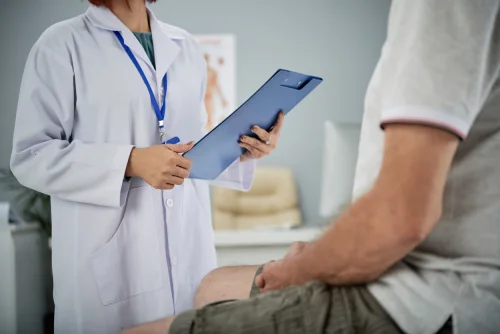
The doctor examines the mole and asks whether it has changed, bled or been regularly irritated. The size and location of the lesion, the likely extent of the procedure and the need for histological examination are assessed.
Local anaesthesia
The area is numbed with a local anaesthetic injection. The patient remains awake but usually feels no pain while the lesion is removed. A touch or slight pressure may be felt.
Excision of the lesion
The surgeon removes the mole or other skin lesion. The extent of the procedure depends on the size, depth and location of the lesion.
Wound closure
After the lesion is removed, bleeding is stopped and the wound is usually closed with stitches. A sterile dressing is applied at the end of the procedure.
Histological examination
The removed lesion can be sent for histological examination. In the laboratory, a pathologist examines the tissue under a microscope to determine the type of lesion and check for atypical or malignant cells.
Histological examination costs €40.
How to prepare for the procedure
Special preparation is usually not required. Before the procedure, tell the surgeon about:
- any medications you take regularly;
- use of blood thinners;
- blood clotting disorders;
- allergies to medications or anaesthetics;
- previous prominent or keloid scars;
- pregnancy;
- any inflammation or infection at the procedure site.
Do not stop blood thinners on your own. Only a doctor may decide on any changes to your treatment.
Healing after mole removal
After the procedure, there may be mild tenderness, redness or swelling. The surgeon will explain how to care for the wound, when to change the dressing and how long to limit physical activity.
During healing, it is recommended to:
- keep the wound clean and follow the doctor’s instructions;
- not soak the wound until the doctor allows it;
- avoid movements that stretch the wound edges;
- not pick off scabs or remove the stitches yourself;
- protect the scar from the sun once it has healed.
The post-operative check-up and suture removal are included in the procedure price.
Contact the clinic if pain, redness or swelling increases, there is pus-like discharge, bleeding does not stop or you develop a fever.
Will there be a scar after mole removal?
Every surgical skin incision leaves a scar. Its appearance depends on the size and location of the lesion, individual skin characteristics, wound care and the patient’s tendency to form prominent scars.
The surgeon plans the direction of the incision and the wound closure so that the scar is as neat as possible. However, a completely scar-free result after surgical excision cannot be promised.
Where to have a mole removed in Riga?
A mole should be removed at a medical facility, where the doctor assesses its appearance, location and the most suitable removal method before the procedure. It is important not only to remove the visible part of the lesion but also, if necessary, to preserve the tissue for histological examination.
At Republikas laukuma klīnika in central Riga, moles and other skin lesions are surgically removed by a general surgeon. The procedure is performed under local anaesthesia, and the removed lesion can be sent for histological examination.
The first step is a surgeon consultation. During it, the doctor:
- examines the mole and assesses its features;
- finds out whether the lesion has changed or is regularly irritated;
- chooses the most suitable removal method;
- explains the procedure and the likely scar;
- decides whether dermatoscopy or histological examination is needed;
- confirms the price of the procedure.
If a mole has changed colour, shape or size, has irregular edges, bleeds, itches or does not heal, a dermatologist consultation and dermatoscopy may be needed before removal.
When should a mole definitely be checked?
A doctor’s examination is needed if a mole:
- has become asymmetric;
- has developed irregular edges;
- contains several shades of colour;
- is getting bigger;
- changes its appearance within a short time;
- starts to itch, hurt or bleed;
- does not heal;
- looks different from your other moles.
In these cases, a mole should not be treated as a purely cosmetic problem. Its nature and the most suitable method of diagnosis or treatment should be assessed first.
Frequently asked questions
Does mole removal hurt?
The procedure is performed under local anaesthesia. The anaesthetic injection may be briefly uncomfortable, but you usually feel no pain while the lesion is being removed.
How much does mole removal cost?
Surgical removal of one small skin lesion under local anaesthesia costs €100–140. Removal of a lesion on the face, scalp or another difficult area costs €160–190. A surgeon consultation costs €60, and histological examination costs €40.
Is histology included in the procedure price?
No. Histological examination costs €40. The doctor decides whether it is needed, based on the type of lesion and its clinical features.
Do I have to pay separately for suture removal?
No. The post-operative check-up and suture removal are included in the procedure price.
Is surgical removal better than laser removal?
If the whole lesion needs to be removed or histological examination is required, the surgical method is the better choice. Other removal methods may be suitable for certain benign lesions assessed by a doctor.
Can several lesions be removed at once?
Yes, in some cases several small lesions can be removed during one procedure. Each additional lesion costs €40–60. The surgeon determines the possible scope of the procedure.
Where can I have a mole removed in Riga?
You can have a mole removed at Republikas laukuma klīnika in central Riga. The surgeon first examines the lesion and assesses the most suitable removal method. The procedure is performed under local anaesthesia, and the removed tissue is sent for histological examination if needed.
Book mole removal
If a mole bothers you, is regularly irritated or has changed in appearance, book a general surgeon consultation at Republikas laukuma klīnika. A consultation in English can be arranged.
Address: Republikas laukums 3–18, “Centra nams”, 1st floor. Entrance from the Ministry of Agriculture side.
Have a question?
Contact our reception – we will help you choose the right specialist and book.