
The liver is one of the most important and complex organs in the human body, with a unique ability to regenerate. Yet despite its importance, there are many myths and much misinformation about liver health. In this article, based only on authoritative international medical sources (such as the NHS, Mayo Clinic, Johns Hopkins Medicine and EASL guidelines), we explain where the liver is, why it does not hurt directly, what “a liver cyst”, “symptoms of an enlarged liver” and “fatty liver” mean, and we decode the complex term “diffuse liver parenchymal changes”.
The liver performs more than 500 vital functions, including filtering the blood, removing toxins, producing bile for digestion and storing nutrients. It is the body’s main biochemical laboratory. Life is impossible without a functioning liver.
Where is the liver located?
A wrong idea of where the liver is can lead to incorrect self-diagnosis. It sits in the upper right quadrant of the abdomen, just below the diaphragm (the muscle that separates the chest from the abdomen). Most of the liver lies under the ribs, which protect it from injury. It is a large, reddish-brown, wedge-shaped organ that weighs about 1.2 to 1.5 kilograms in an adult.
The liver consists of two main lobes – right and left – which are divided into smaller segments. It has a unique blood supply: about 75% of the blood arrives through the portal vein (vena portae) from the digestive tract, carrying nutrients and toxins, while the remaining 25% comes through the hepatic artery, supplying the organ with oxygen.
Liver pain – myth or reality?
Many people who feel discomfort in their right side say, “My liver hurts”. However, this is not medically accurate. The liver tissue itself (the parenchyma) has no pain receptors. That is why early liver diseases are often completely symptomless and are discovered by chance.
So what causes the pain? The liver is covered by a thin, dense capsule called Glisson’s capsule. Pain occurs only when this capsule is stretched or irritated. This can happen for various reasons:
- Acute liver enlargement – for example, in acute hepatitis or congestive heart failure, when the liver quickly increases in size and stretches the capsule.
- Tumours or cysts – if they are close to the capsule and press on it.
- Inflammation around the liver – for example, perihepatitis.
When a person feels “pain in the liver area”, it is most often a dull, aching or pressing sensation in the upper right quadrant. Less often it can be sharp. The pain may spread to the right shoulder or back. So if you feel discomfort in this area, it is important to see a doctor rather than assume that “the liver hurts”.
Enlarged liver, or hepatomegaly
Hepatomegaly is not a disease in itself, but a symptom pointing to an underlying problem. Symptoms of an enlarged liver can be very non-specific and easily confused with other conditions. Many people with an enlarged liver notice no changes at all. When symptoms do appear, they may include:
- A feeling of heaviness or discomfort – dull pain or a feeling of fullness in the upper right abdomen.
- Fatigue – tiredness and general weakness very often accompany liver disease.
- Nausea and vomiting.
- Loss of appetite.
- Jaundice – yellowing of the skin and the whites of the eyes, a sign of impaired bilirubin metabolism.
- Increased abdominal size – this may be caused by the liver itself or by ascites (fluid build-up in the abdomen), which is a sign of serious liver failure.
- Dark urine and pale stools.
Why does the liver become enlarged?
- Hepatitis – viral (A, B, C, D, E), alcohol-related or autoimmune inflammation.
- Fatty liver disease.
- Chronic liver disease, or liver cirrhosis.
- Tumours (primary liver cancer or metastases).
- Heart and blood vessel problems – for example, congestive heart failure, which causes blood congestion in the liver.
- Inherited metabolic diseases.
Liver cyst – is it dangerous?
A liver cyst is one of the most common findings on abdominal ultrasound or CT scans. A cyst is a fluid-filled sac in the liver tissue. Fortunately, most liver cysts are benign (not cancer) and cause no symptoms or problems.
There are several types of liver cysts:
- Simple cysts – the most common type. They are usually congenital, grow slowly and rarely become large. They need no treatment unless they cause symptoms.
- Polycystic liver disease – an inherited condition in which many cysts form in the liver. It may also be linked to cysts in the kidneys.
- Parasitic cysts – for example, echinococcosis, caused by tapeworms. These cysts can be dangerous and need specific treatment (medical and/or surgical).
- Cystadenomas – rare, benign tumours that can become very large and sometimes turn malignant (become cancer).
Most simple cysts are found by chance. Treatment is needed only if the cyst becomes very large and starts pressing on nearby organs or the capsule, causing pain, or if a parasitic origin or malignancy is suspected.
Golden rule: if you have been diagnosed with a liver cyst, don’t rest until your doctor has clarified its type and potential risks.
Hepatic steatosis, or fatty liver
Hepatic steatosis, known in medicine as non-alcoholic fatty liver disease (NAFLD) or, by the newer term, metabolic dysfunction-associated fatty liver disease (MAFLD), has become one of the most common liver diseases in the world, especially in Western countries. It is closely linked to obesity, type 2 diabetes, high cholesterol and high blood pressure.
What is hepatic steatosis?
It is a condition in which too much fat builds up in the liver cells (hepatocytes). Normally the liver contains a small amount of fat, but if fat makes up more than 5–10% of the liver’s weight, fatty liver disease is diagnosed.
The disease has two main stages:
- Simple steatosis – fat build-up without inflammation or tissue damage. In most people, the disease does not progress at this stage and causes no serious problems.
- Non-alcoholic steatohepatitis (NASH) / metabolic dysfunction-associated steatohepatitis (MASH) – a more severe stage in which fat build-up causes inflammation and damage to liver cells. NASH/MASH can lead to liver fibrosis (scarring), which may progress to cirrhosis and increase the risk of liver cancer.
Important! Hepatic steatosis is often completely symptomless. It can only be detected by an ultrasound scan or raised liver values (ALT, AST, GGT) in blood tests. The main treatment strategy is lifestyle change: weight loss (gradual and controlled), a healthy diet (Mediterranean diet), regular physical activity and control of related conditions (diabetes, cholesterol).
Diffuse liver parenchymal changes – what does it mean?
If you see the term “diffuse liver parenchymal changes”in an ultrasound or other imaging report, don’t panic – understand what it actually means.
This is not a specific diagnosis, but a radiological description. It means that changes in the liver tissue structure are spread throughout the organ, rather than concentrated in one specific place (like a cyst or tumour). “Diffuse” means “spread out”, and “parenchyma” is the functional tissue of the liver.
“Changes” in this context can mean different things:
- Most often – fatty liver disease – fat build-up changes the density of the liver tissue, which appears as diffuse changes on ultrasound.
- Chronic inflammation, or hepatitis – long-term inflammation causes fibrosis, which changes the liver’s structure.
- Cirrhosis – severe scarring completely remodels the liver’s structure, which is very clearly visible on imaging.
So diffuse liver parenchymal changes are a signal that the liver needs further investigation. The doctor will usually order blood tests to check liver function and may carry out more specific tests (such as elastography or even a liver biopsy) to determine the exact cause and severity of the changes.
Liver health – diagnosis and recommendations
A liver check-up is important, especially if you have risk factors (obesity, diabetes, alcohol use, hepatitis risk). International guidelines (such as EASL) recommend:
- Regular blood tests – measuring liver enzymes (ALT, AST, GGT) and bilirubin. This is the first step in detecting potential liver damage.
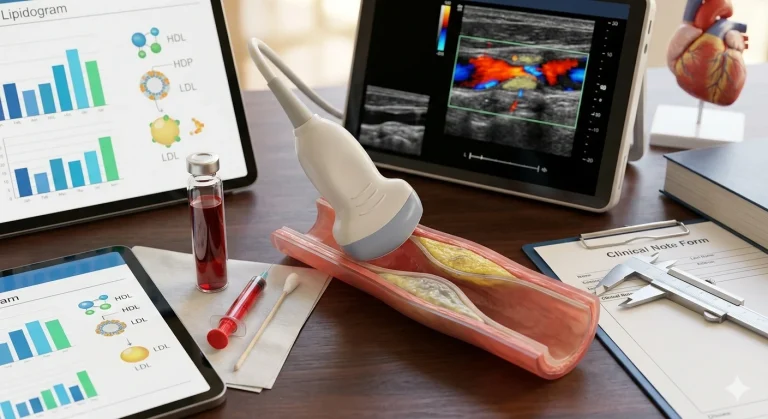
- Abdominal ultrasound (USG) – allows the doctor to assess the size and structure of the liver and detect cysts, tumours and fatty liver disease.
- Hepatitis virus tests – especially testing for hepatitis B and C.
- Further diagnostics – if needed, the doctor may order a CT scan, MRI, elastography (to measure liver stiffness) or a liver biopsy.
Golden rule: Don’t try to treat yourself with “liver detox” products or supplements without consulting a doctor. Most of them have no scientific basis, and some can even harm the liver. The best liver “detox” is a healthy lifestyle and regular medical check-ups.
Questions about your health?
Specialist doctors see patients at Republikas laukuma klīnika in central Riga. Our reception will help you choose the right specialist and time.