
Republikas laukuma klīnika
Vascular Doppler ultrasound in Riga
Vascular Doppler ultrasound (duplex ultrasound) shows the structure of blood vessels and how blood flows through them. In central Riga we examine the veins and arteries of the legs and arms, the neck (brachiocephalic) vessels, the renal vessels and the aorta. Leg, arm and neck vessel examinations are performed by radiology resident Dr. Anda Lita Vāvere.
Who performs the examination
Doppler ultrasound is performed by a radiology resident. If you need treatment or an assessment for surgery, book a consultation with a vascular surgeon.

Dr. Anda Lita Vāvere
Radiology resident
Performs Doppler ultrasound of the leg, arm and neck vessels. Sees patients aged 18 and over.

Dr. med. Roberts Rumba
Vascular surgeon, phlebologist
Consultation and treatment plan. If needed, performs a Doppler scan during the consultation (consultation with Duplex scan – 100 €).
Doppler ultrasound tests and prices
Each examination is a separate service with its own price. When booking, tell us which area needs to be examined – if you are not sure, our reception will help you choose.
| Examination | What it assesses | Duration | Price |
|---|---|---|---|
| Leg vein Doppler | Deep and superficial veins, valve function, venous reflux, blood clots | ~20 min | 70 € |
| Leg artery Doppler | Arteries from the groin to the foot, narrowing and blockages | ~20 min | 70 € |
| Brachiocephalic (neck) vessel Doppler | Carotid, vertebral and subclavian arteries in the neck, atherosclerotic plaques | ~30 min | 120 € |
| Arm vein Doppler | Deep and superficial veins of the arms, blood clots | ~20 min | 70 € |
| Arm artery Doppler | Arteries from the shoulder to the hand, blood flow disorders | ~20 min | 70 € |
Durations are approximate and depend on the area examined and the number of measurements. All prices are in the price list.
What is Doppler (duplex) ultrasound?
Doppler ultrasound is an ultrasound of the blood vessels that combines two types of information:
- an anatomical image of the vessel, showing its walls and lumen;
- Doppler measurements that assess the direction and speed of blood flow.
This is why the examination is also called duplex ultrasound, DUPLEX or vascular Doppler – the names are used interchangeably. It can help detect venous reflux, thrombosis, arterial narrowing, blockages and atherosclerotic changes.
Doppler ultrasound is painless and non-invasive – no X-rays are used and no contrast agent is injected.
Leg vein Doppler ultrasound
A leg vein Doppler assesses the deep and superficial veins, the direction of blood flow, vein patency and valve function. It helps determine whether leg swelling, heaviness, visible veins or other symptoms may be caused by venous reflux.
When is a leg vein Doppler recommended?
The examination may be needed if you have:
- swelling in one or both legs;
- a feeling of heaviness or pressure in the legs;
- visible, enlarged or bulging veins;
- pain or discomfort after standing for a long time;
- changes in skin colour or texture on the lower legs;
- recurring leg cramps together with other symptoms of vein disease;
- suspected deep vein thrombosis;
- a previous venous thrombosis;
- a need for vein assessment before treatment or surgery;
- a need for follow-up after vein treatment.
Leg swelling does not always mean vein disease – it can also be caused by the heart, kidneys, lymphatic system, medication or other factors. Doppler ultrasound helps assess whether the symptoms are related to vein function.
If you need treatment for vein disease, book a phlebologist consultation.
Price: 70 € · duration ~20 min
Leg artery Doppler ultrasound
A leg artery Doppler assesses the arteries that supply blood to the leg tissues. It locates blood flow disorders and assesses possible narrowing or blockage of the arteries.
When is a leg artery Doppler recommended?
The examination may be recommended if you have:
- pain or cramps in the calves when walking that ease after stopping;
- cold feet or marked coldness in one leg;
- pale, bluish or otherwise discoloured feet or toes;
- slow-healing wounds on the feet or lower legs;
- a weak or hard-to-find pulse in the feet;
- known peripheral artery disease;
- diabetes together with signs of circulation problems;
- atherosclerosis in other vascular areas;
- a need for follow-up after vascular surgery or other treatment.
Smoking, diabetes, high cholesterol, high blood pressure and age increase the risk of peripheral artery disease. It is best to discuss the need for a preventive examination with your doctor.
If artery disease is suspected or treatment needs to be assessed, book a vascular surgeon consultation.
Price: 70 € · duration ~20 min
Brachiocephalic (neck) vessel Doppler ultrasound
A brachiocephalic Doppler examines the neck arteries that supply blood to the brain – the carotid, vertebral and subclavian arteries. The doctor assesses the vessel walls, blood flow, possible atherosclerotic plaques and the degree of narrowing.
When is a neck vessel Doppler recommended?
Your doctor may recommend the examination if:
- you have had a stroke or a transient ischaemic attack;
- you have known atherosclerosis in other vascular areas;
- the doctor has heard a bruit over a neck artery;
- a narrowing of a neck artery has been found before;
- follow-up is needed after neck artery surgery or other treatment;
- you have several significant cardiovascular risk factors – high blood pressure, diabetes, high cholesterol;
- the examination has been ordered by a neurologist, cardiologist, family doctor or vascular surgeon.
Dizziness or headaches alone do not necessarily indicate neck artery disease. The doctor decides on the need for the examination together with your symptoms, medical history and other risk factors.
When do you need emergency help? If you suddenly develop facial drooping, weakness in one arm or leg, numbness, slurred speech, sudden loss of vision or balance problems, do not wait for a scheduled examination – call 113 immediately.
Price: 120 € · duration ~30 min
Arm vein and artery Doppler ultrasound
An arm Doppler assesses the veins or arteries of the arms and the blood flow in them. Vein and artery examinations are separate services – please specify which one you need when booking.
- Arm veins – for example, in case of swelling, pain or suspected thrombosis.
- Arm arteries – for example, if the arm tires quickly, is cold or pale, or blood pressure differs between the arms.
Price: 70 € per examination · duration ~20 min
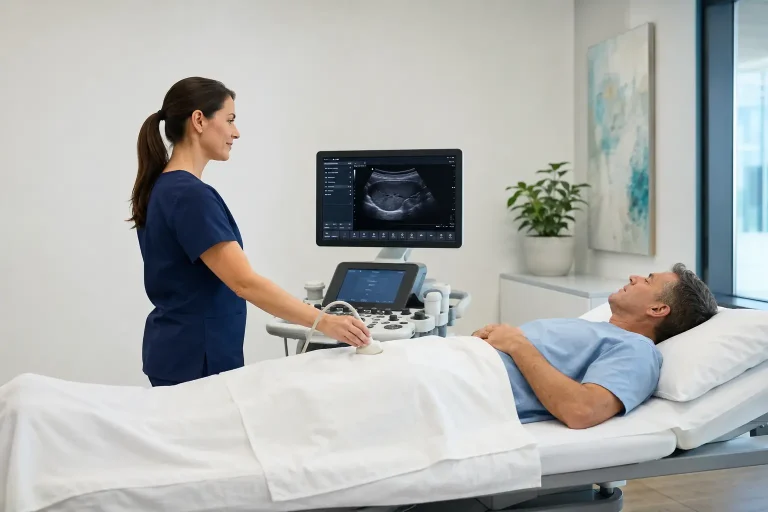
How is a vascular Doppler ultrasound performed?
During the procedure:
- you lie down, sit or stand, depending on the examination;
- ultrasound gel is applied to the area being examined;
- the doctor examines the vessels with an ultrasound probe and assesses the direction and speed of blood flow;
- additional measurements or functional tests are performed if needed.
During a leg vein examination, the doctor may press the probe lightly against the leg to check whether the veins compress. You may be asked to hold your breath, change position or stand up. The examination is not painful, although brief discomfort may occur if the probe is pressed on a tender or swollen area.
What you receive after the examination
After the Doppler ultrasound, the doctor explains the main findings and prepares a written report that you can show to your treating doctor. The report describes the condition of the vessels and blood flow; the diagnosis and treatment are decided by your treating doctor, taking into account your symptoms and other tests.
How to prepare for a Doppler ultrasound
Leg, arm and neck vessels
No special preparation is needed.
- wear comfortable clothing that allows access to the area being examined;
- do not apply cream or oil to the skin before a leg or arm examination;
- remove necklaces before a neck examination.
Renal vessels and aorta
Come on an empty stomach – do not eat for at least 6 hours before the examination. If the examination is before 12:00, skip breakfast. The day before, avoid foods that cause bloating (legumes, fizzy drinks, dairy). Before the examination, do not drink coffee, chew gum or smoke. You may take your regular medication with a little still water.
In all cases, bring your referral (if you have one) and the results of previous vascular examinations. Keep taking your regular medication unless your doctor has told you otherwise.
Frequently asked questions
Are Doppler and duplex ultrasound the same thing?
In everyday use the names are interchangeable. Duplex ultrasound combines an anatomical image of the vessel with an assessment of blood flow.
Does one examination check both the leg veins and arteries?
No. Leg vein and leg artery Doppler are separate examinations with different diagnostic purposes – each costs 70 €. If you need both, mention it when booking so that enough time is reserved.
Do I need a referral for a Doppler ultrasound?
A referral may not be required for a paid examination. However, when booking you need to know which vascular area should be examined. If the cause of your symptoms is unclear, a doctor’s consultation may be needed first.
Can Doppler ultrasound diagnose venous thrombosis?
Leg vein duplex ultrasound is one of the main examinations used when deep vein thrombosis is suspected. Sudden swelling and pain in one leg or sudden shortness of breath require urgent medical assessment.
Is a Doppler ultrasound painful?
Usually not. Mild discomfort may occur if the doctor has to press the probe on a painful or swollen area.
Can a Doppler ultrasound be done during pregnancy?
Doppler ultrasound does not use ionising radiation. If there is a medical indication, it can be performed during pregnancy.
How long does a Doppler ultrasound take?
Most examinations take about 20 minutes. The longest is the neck and head vessel examination – about 30 minutes.
Can I take my regular medication before a Doppler ultrasound?
Usually you can continue taking your regular medication. Do not stop any medication without consulting your doctor.
What is the difference between a Doppler scan and a vascular surgeon consultation?
A Doppler ultrasound is a diagnostic examination performed by a radiology resident, after which you receive a report. At a vascular surgeon consultation, the doctor assesses your symptoms and test results and draws up a treatment plan. Dr. Roberts Rumba can perform a Doppler scan during the consultation if needed.
How should I prepare for a renal vessel or aortic Doppler?
Come on an empty stomach – do not eat for at least 6 hours before the examination, and avoid foods that cause bloating the day before. You may take your regular medication with a little water. No special preparation is needed for leg, arm and neck vessel examinations.
Not sure which Doppler examination you need?
Contact reception and we will help you choose and book.